Legal / Professional Services Simulation

Legal Firm Workflow Planning

An operational-state planning engagement for multi-office legal practices. Simulation is one stage of the workflow, used to model how matters move through intake, lifecycle, and closeout, surface coordination delays and capacity constraints before they show up as missed deadlines, and stress-test the firm under realistic staffing and volume changes.

An operational-state simulation, not an RF or physical model

This engagement models how legal matters, administrative tasks, approvals, staffing capacity, billing activity, and client-facing workflows move through a multi-office professional services environment. It is intentionally not an RF, wireless, or physical-coverage model. It is an operational-state simulation that shows how work moves through attorneys, paralegals, intake staff, billing, administrative support, calendars, document systems, email, and client-facing workflows, and where that movement stalls, accumulates, or breaks down.

The objective is to help leadership understand where coordination delays form, how workload shifts between offices and roles, what happens under staffing or matter-volume changes, and which workflow interventions improve planning, reliability, cost, schedule, client service, and operational performance. The simulation turns invisible operational dynamics into visible, manageable tradeoffs before those dynamics produce client complaints, missed deadlines, or revenue delay.
Workflow problems propagate

The model starts at intake and builds toward firm-wide coordination because workflow problems do not stay where they originate. Intake quality affects assignment. Assignment affects workload. Workload affects review timing. Review timing affects client response, billing, and closeout. Each stage of the simulation reveals a different layer of that propagation.

Without seeing the full chain, downstream symptoms routinely get mistaken for root causes. Skipping intake modeling can hide bad upstream data quality that drives rework later. Skipping lifecycle-state modeling can hide blocked matters that are consuming attorney attention without moving forward. Skipping cross-office modeling can hide handoff delays that only become visible when a matter misses a deadline. Skipping capacity modeling can misclassify a staffing constraint as a software issue.

The sequence is the safeguard against each of those misdiagnoses.

Eight stages. Each one answering a different question.

The simulation moves from intake routing through workflow telemetry calibration. Each stage below produces a specific artifact and answers a specific operational question. Figures shown are representative. Actual outputs are produced against the firm's specific office structure, role mix, matter lifecycle, and operating data.

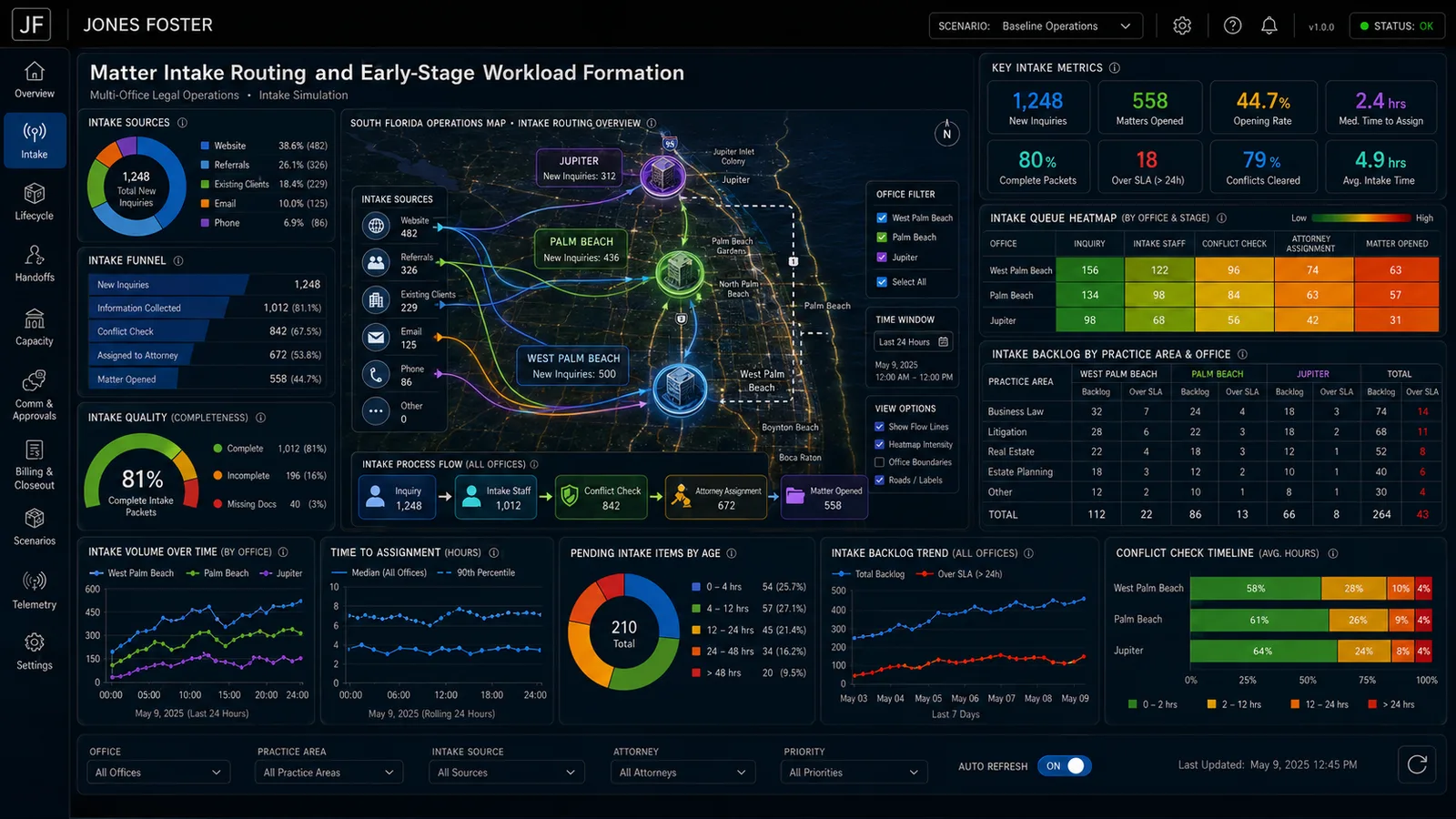
01 /Matter Intake Routing and Early-Stage Workload Formation
New matters captured, checked, routed, and assigned across the firm.

The intake stage models how new matters enter the firm: conflict checks, intake completeness, source channels, attorney assignment rules, and workload formation as matters land in queues. It exposes intake quality issues and assignment patterns that compound downstream.

Multi-office intake flow, queue heatmaps, conflict-check timelines, and backlog trends anchor the rest of the model in how matters actually start.

Matter intake routing and early-stage workload formation
FIG 01Matter Intake Routing & Early-Stage Workload Formation · Multi-Office Intake Flow · Queue Heatmap · Conflict-Check Timeline · Backlog Trend

NoteActual outputs reflect the firm's specific intake sources, conflict-check workflow, attorney assignment rules, office staffing, and matter-type distribution.

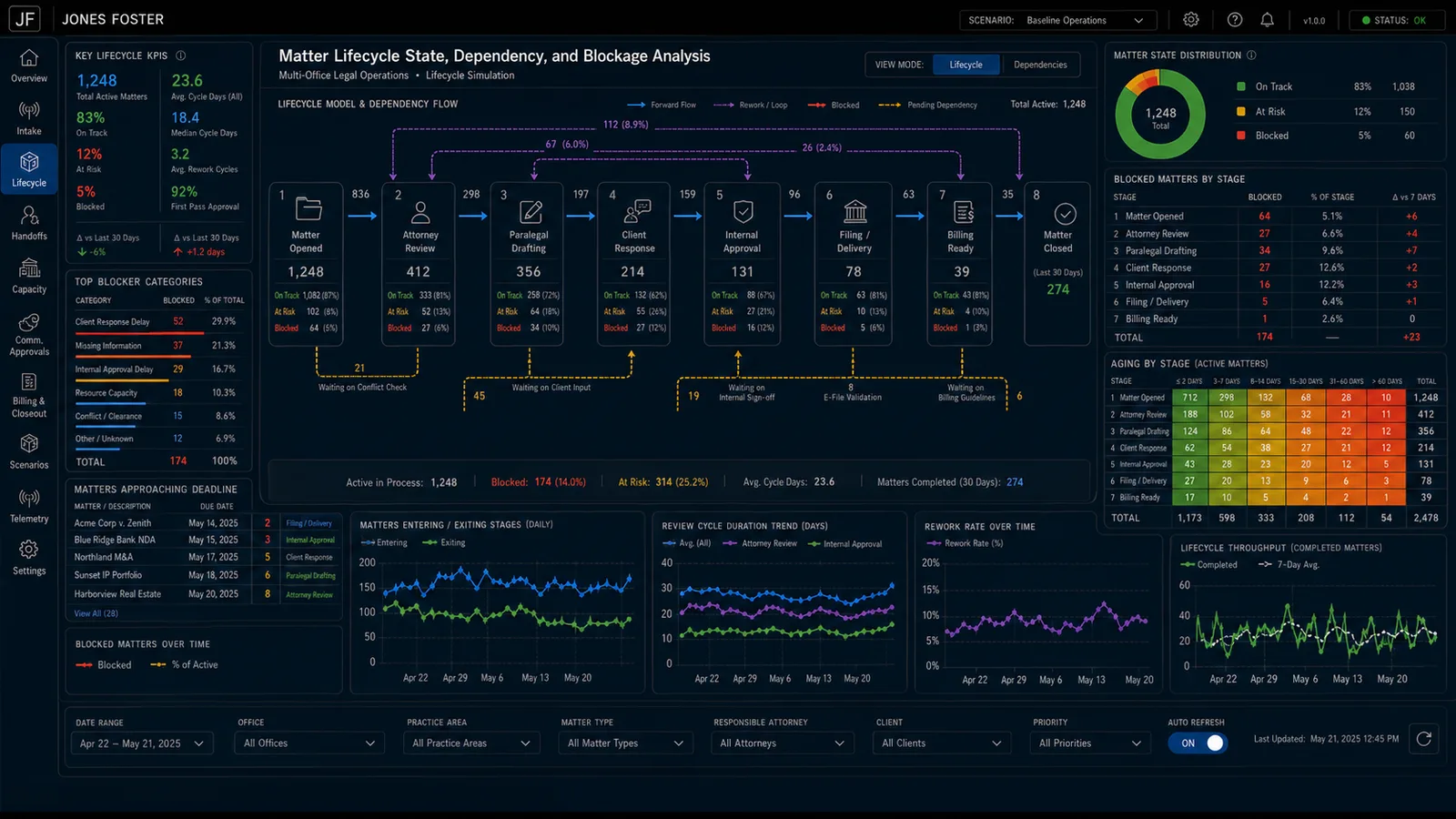
02 /Matter Lifecycle State, Dependency, and Blockage Analysis
Where matters are delayed, blocked, waiting, or nearing deadline.

The lifecycle stage models matter progression through workflow stages and the dependencies that bind them. Lifecycle models, dependency flows, blocked-matters-by-stage views, and aging distributions surface structural blockage patterns that drive missed dates and downstream overflow.

Matters that look active in a billing report but are actually stalled are identified. The model distinguishes work in progress from work in queue.

Matter lifecycle state, dependency, and blockage analysis
FIG 02Matter Lifecycle State, Dependency & Blockage · Lifecycle Model · Dependency Flow · Blocked Matters by Stage · Aging Distribution

NoteActual outputs reflect the firm's specific workflow stages, matter types, attorney and paralegal assignments, approval steps, and filing requirements.

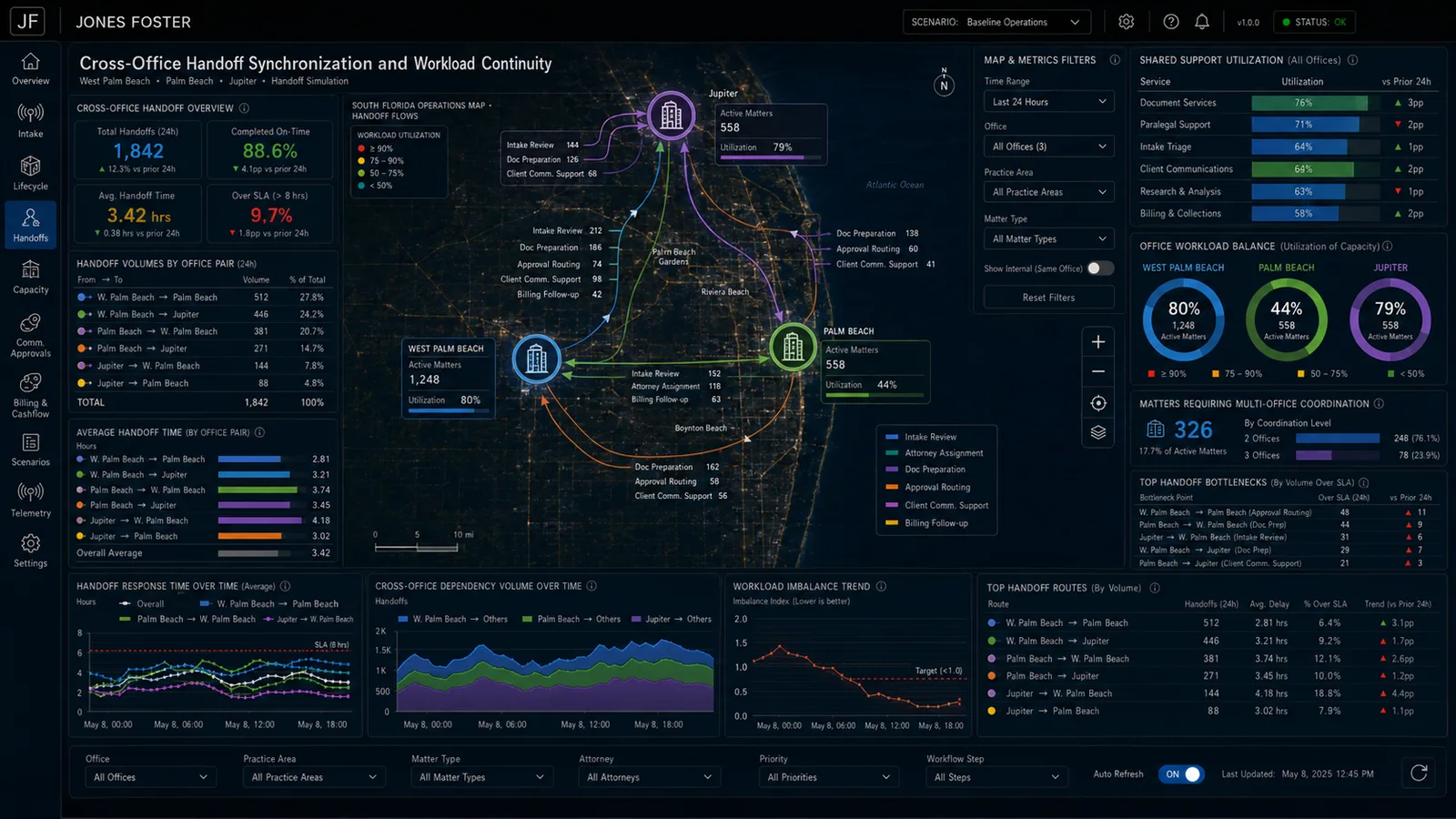
03 /Cross-Office Handoff Synchronization and Workload Continuity
Office coordination, handoff stalls, and workload imbalances across the network.

This stage models matter and support-work flow across the firm's office network. Operations maps, handoff volumes, office workload balance, and bottleneck analysis show where work moves smoothly, where it pools, and where the network operates as parallel offices rather than as one firm.

Handoff delays that are invisible to any single office are surfaced at the network level.

Cross-office handoff synchronization and workload continuity
FIG 03Cross-Office Handoff Synchronization · Operations Map · Handoff Volumes · Office Workload Balance · Bottleneck Analysis

NoteActual outputs model handoff volumes, timing, and bottlenecks for the firm's specific multi-office network, matter routing rules, and shared support structure.

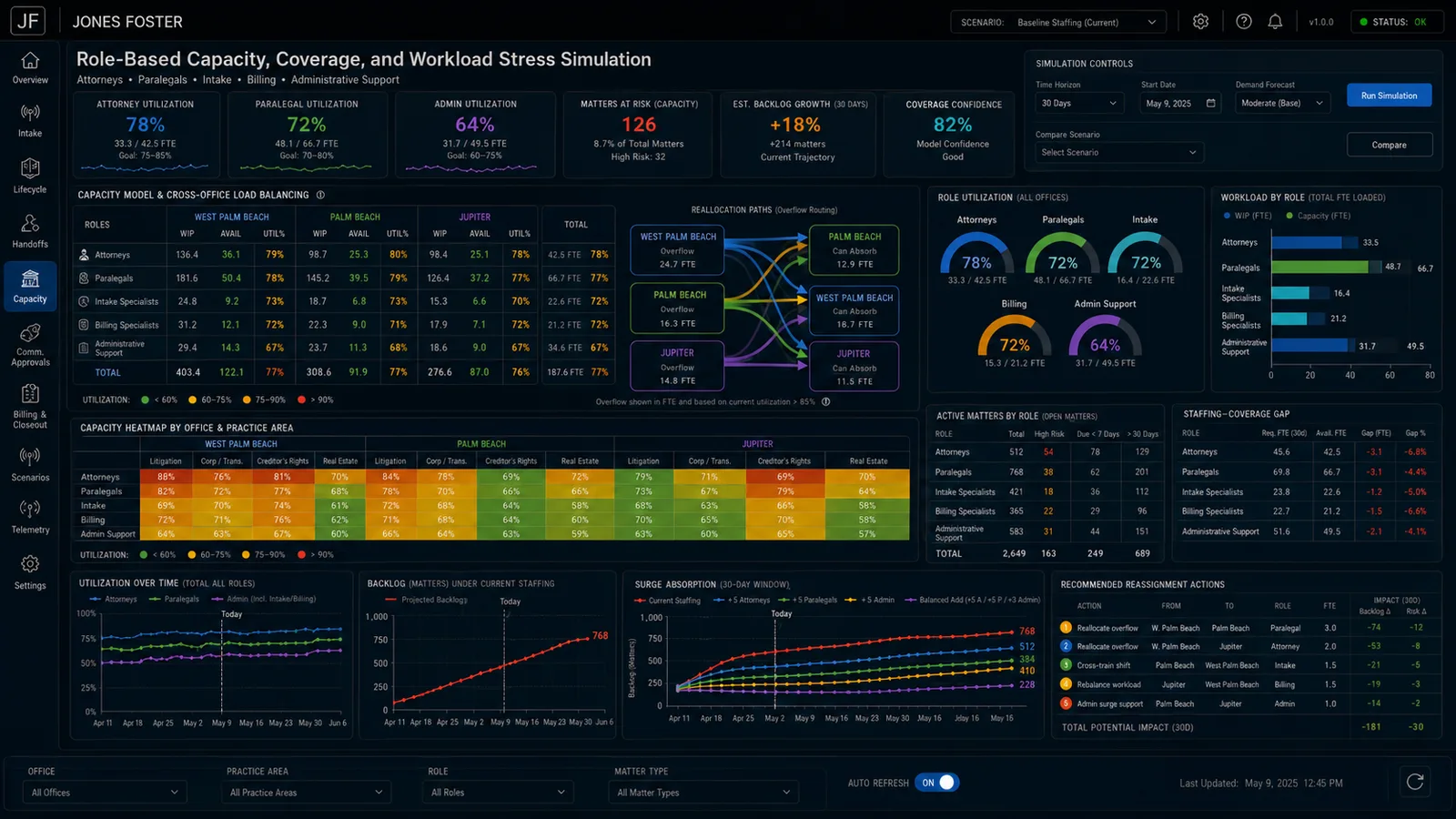
04 /Role-Based Capacity, Coverage, and Workload Stress Simulation
Where the firm's capacity is actually constrained.

This stage models capacity by role and office: attorney, paralegal, intake, billing, administrative support. Utilization heatmaps, capacity-by-office views, surge absorption, and recommended reassignments show where the firm has slack and where it is overloaded.

Leadership sees where capacity is actually constrained, which is rarely where intuition says it is. Hiring, cross-staffing, and process-improvement decisions are made against evidence rather than against the loudest concern.

Role-based capacity, coverage, and workload stress
FIG 04Role-Based Capacity & Workload Stress · Utilization by Role and Office · Capacity Heatmap · Surge Absorption · Recommended Reassignments

NoteActual outputs reflect the firm's specific FTE counts, active matter loads, practice area distribution, and staffing assumptions by office and role.

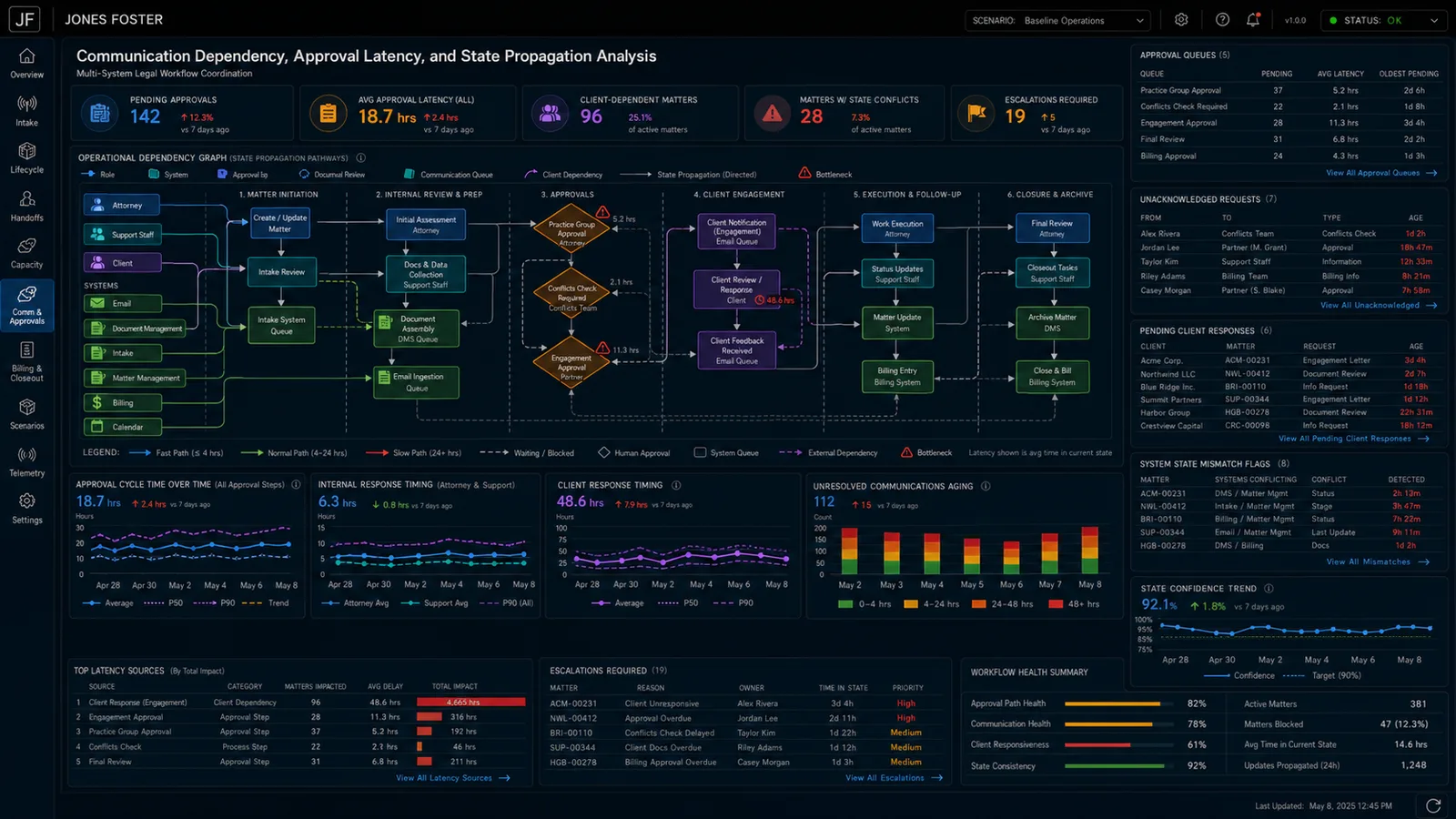
05 /Communication Dependency, Approval Latency, and State Propagation
Information flow, approval stalls, and state ambiguity across people and systems.

This stage models communication and approval workflows: dependency graphs, approval cycle times, client response aging, and state confidence trends. Approval requests buried in email chains, client responses left in inboxes, and matter-state ambiguity across systems become visible.

The result is a clearer picture of where information friction is consuming throughput that staffing alone cannot recover.

Communication dependency, approval latency, and state propagation
FIG 05Communication Dependency & Approval Latency · Dependency Graph · Approval Cycle Time · Client Response Aging · State Confidence Trend

NoteActual outputs model communication and approval workflows using the firm's specific systems, approval chains, client-facing processes, and matter-state definitions.

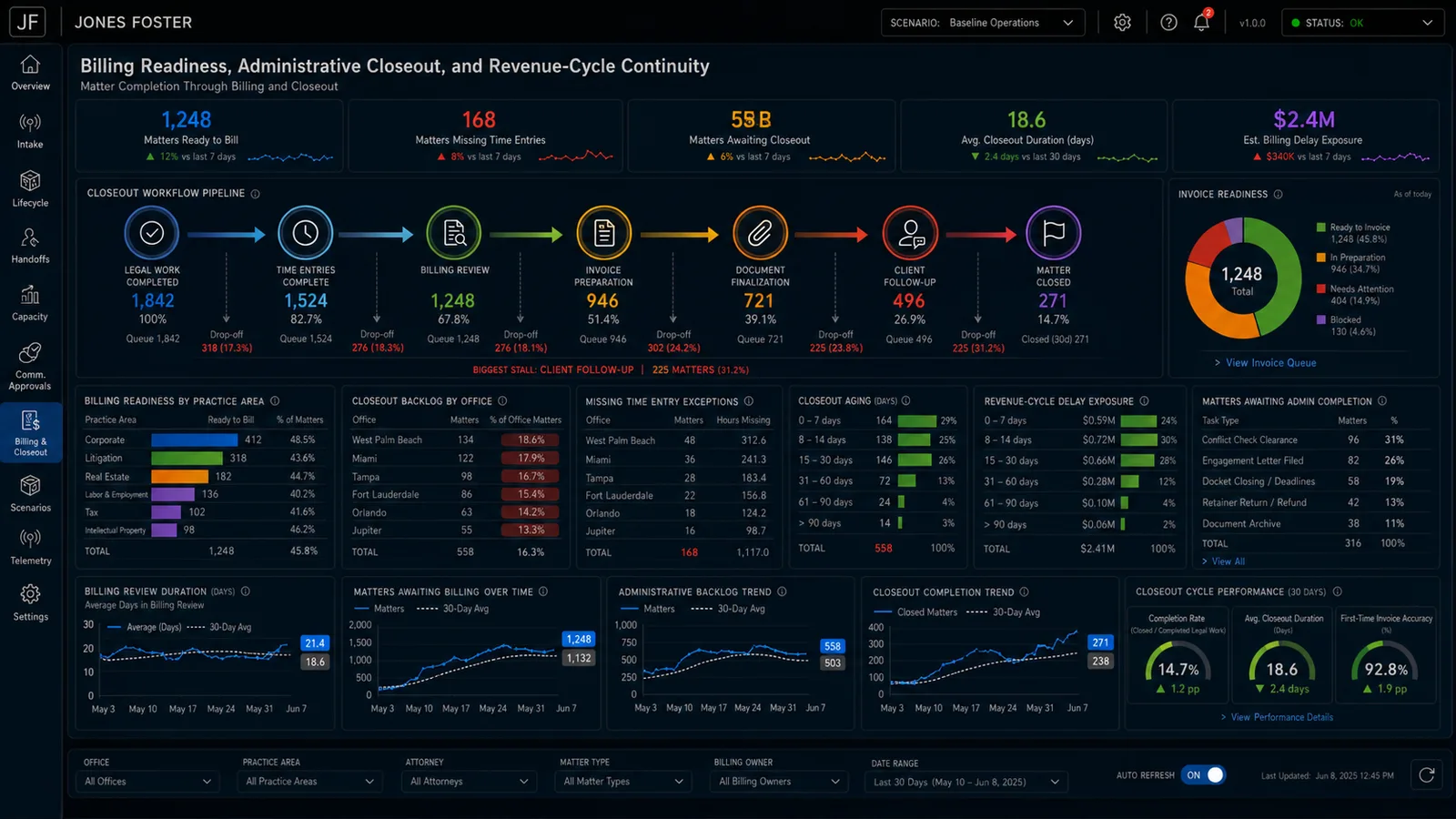
06 /Billing Readiness, Administrative Closeout, and Revenue-Cycle Continuity
Where completed legal work remains operationally unfinished.

This stage models the closeout pipeline: billing readiness by practice area, revenue delay exposure, and aging distribution of completed-but-unbilled work. The administrative tail of completed matters often holds material revenue, and this stage quantifies it.

The result is a defensible view of where to intervene in the revenue cycle to recover cash that the workflow has earned but has not yet captured.

Billing readiness, administrative closeout, and revenue-cycle continuity
FIG 06Billing Readiness & Revenue-Cycle Continuity · Closeout Pipeline · Billing Readiness by Practice Area · Revenue Delay Exposure · Aging Distribution

NoteActual outputs reflect the firm's specific billing workflow, time-entry requirements, closeout checklist, and revenue-cycle configuration by office and practice area.

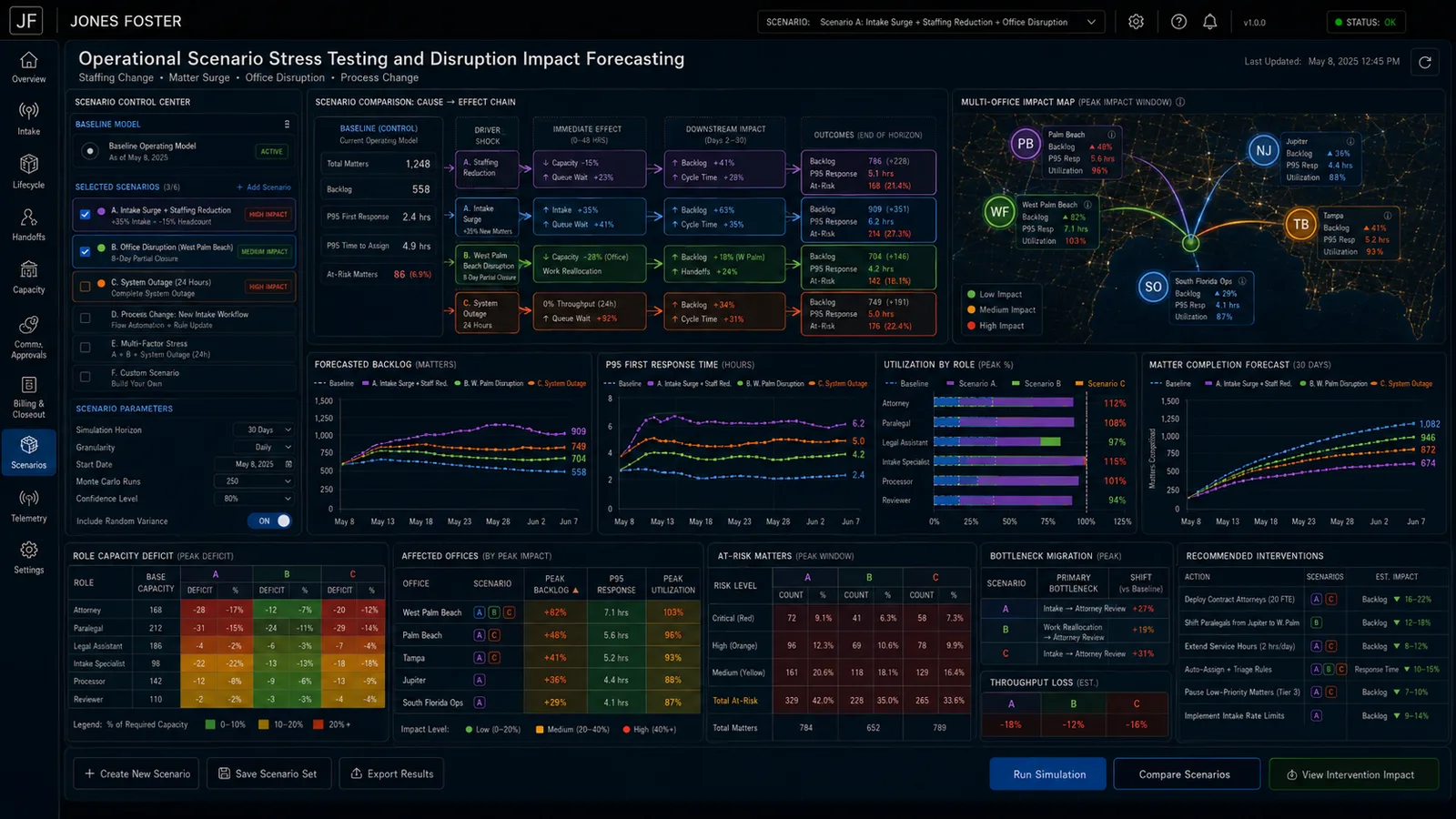
07 /Operational Scenario Stress Testing and Disruption Impact Forecasting
The firm under staffing changes, matter spikes, and disruption.

This stage stress-tests the firm under realistic scenarios: staffing shifts, matter-volume changes, billing pressure, departures, surge intake, or revenue-cycle disruption. Scenario comparisons, cause-effect chains, multi-office impact views, and recommended interventions show how the firm absorbs each scenario.

Commitments made under one set of conditions can be tested against the next. Operational tradeoffs are visible before they have to be made under pressure.

Operational scenario stress testing and disruption impact forecasting
FIG 07Operational Scenario Stress Testing · Scenario Comparison · Cause-Effect Chain · Multi-Office Impact · Recommended Interventions

NoteActual outputs model scenario consequences using the firm's specific baseline workflow, staffing assumptions, matter volumes, and office configurations.

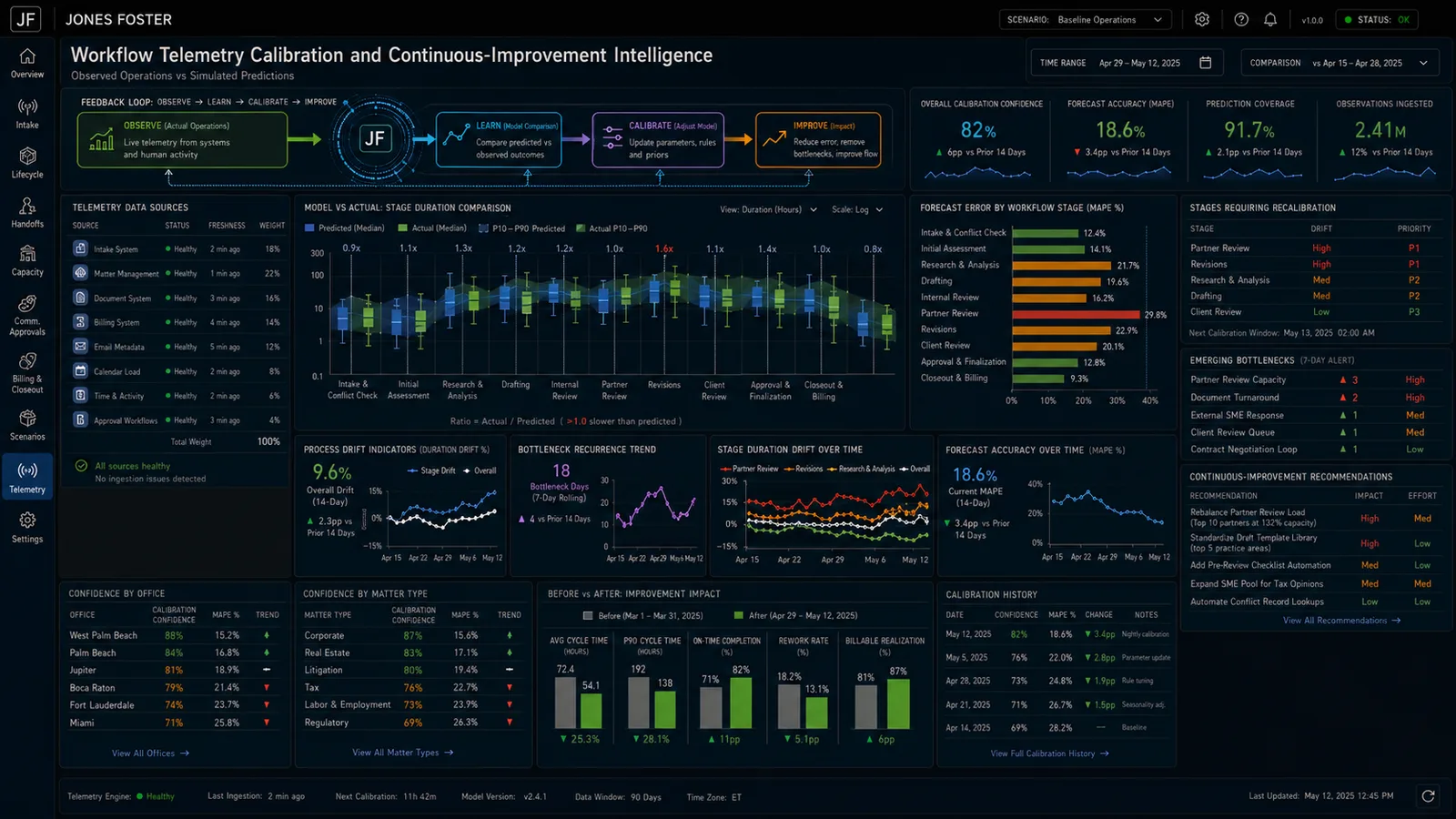
08 /Workflow Telemetry Calibration and Continuous-Improvement Intelligence
Real operating data refines the simulation and tracks improvement over time.

This stage compares predicted workflow against the firm's actual operating data: matter management, billing, document, calendar, and intake systems. Model-versus-actual views, forecast error, process drift, and before-after improvement impact show where the model is accurate and where the firm is changing in ways the model needs to absorb.

Each operating cycle compounds into structured knowledge that improves the next forecast.

Workflow telemetry calibration and continuous-improvement intelligence
FIG 08Workflow Telemetry Calibration · Model vs. Actual · Forecast Error · Process Drift · Before-After Improvement Impact

NoteActual outputs ingest telemetry from the firm's specific matter management, billing, document, calendar, and intake systems, and compare against workflow predictions from the simulation.

Operations you can plan against

The simulation stages feed a small set of consequential decisions. The outcomes below are what firm leadership carries into capacity planning, into client commitments, and into partner conversations.

01 /Capacity Visibility Across Offices
Staffing and workflow constraints made visible.

Staffing constraints, intake-to-assignment latency, and matter-stage dwell times become visible across the office network rather than living as tribal knowledge in each office. Leadership sees where the firm's capacity is actually constrained, which is rarely where intuition says it is, and can allocate hiring, cross-staffing, and process improvement against evidence rather than against the loudest concern in any one office.

02 /Deadline Reliability
Surface at-risk matters before clients see the miss.

Blocked-matter detection and at-risk-matter forecasting let the firm intervene before a deadline slip becomes visible to a client. The matters that would have produced a difficult conversation are caught earlier, rerouted to available capacity, or escalated for partner attention. The client experience of deadline reliability, a key driver of professional-services retention, improves measurably without requiring across-the-board capacity additions.

03 /Defensible Billing and Capacity Charges
Modeled effort feeds rate and capacity decisions.

Modeled effort against matter type, staffing mix, and complexity feeds rate decisions and capacity charges that can be defended to clients and to the partnership. Over time, billable hours track modeled effort more tightly, write-downs decrease, and the firm's economics improve without the kind of rate negotiations that strain client relationships.

04 /Cross-Office Handoff Continuity
Engineer out the coordination delays.

Coordination delays between offices, including matters that stall during transfer, approvals that wait for the right partner, and support staff demand that spikes in one office while sitting idle in another, are surfaced and engineered out. The firm operates as one network rather than as parallel offices that happen to share a name.

Where simulation does not solve the problem alone

Simulation does not replace legal judgment, market demand, or how courts and regulators act. The boundaries below are explicit so the deliverable is read accurately.

01 /Throughput Gains Depend on Demand and Practice Mix
Efficiency does not automatically convert into revenue.

Faster matter flow can free capacity without changing the firm's outcomes if practice-area demand is constrained, if client mix limits how that capacity can be deployed, or if billable realization is held back by rate sensitivity. The simulation shows where time can be recovered. Whether that recovered time becomes revenue depends on commercial conditions outside the model.

02 /Matter and Client Variability Is Bounded
Each matter has facts the model does not see.

The simulation represents matters by stage, dependency, and timing. The intrinsic complexity of a specific matter, unusual client behavior, opposing-counsel dynamics, and the substantive judgment that drives many decisions inside a matter are outside the model. Workflow simulation supports operations leadership; it does not substitute for the legal judgment that determines how each matter actually runs.

03 /External Events Are Out of Scope
Courts, regulators, and clients act on their own timetables.

Court calendar changes, regulatory deadlines, opposing-side delays, and client-driven rescheduling are external to the firm's workflow and are not predicted by the simulation. The model can show how the firm absorbs these events when they occur. It cannot foresee when they will happen or which matters they will land on. Buffer planning, calendar discipline, and operational responsiveness remain the way to handle them.

Integrating Simulation into Multi-Office Firm Operations

Simulation is integrated at the practice-management planning layer, before headcount is committed or service-level commitments are made to clients. Each engagement begins with a scoping call to define the operating envelope: practice areas, matter mix, intake and routing rules, role-based capacity, multi-office handoff patterns, billing and approval workflows, deadline structure, and the client commitments the deliverable must support.

Matter lifecycle states, role capacity, and cross-office handoff geometry are then captured as a working model, and the simulation stages run against the actual operational cases the firm expects to execute. Deliverables include the matter intake routing and early-stage workload formation model, matter lifecycle state and dependency analysis, cross-office handoff synchronization analysis, role-based capacity and workload-stress simulation, communication dependency and approval-latency mapping, billing readiness and revenue-cycle continuity analysis, operational scenario stress testing, workflow telemetry calibration, and a written brief that documents the analysis for firm leadership, practice heads, and operational reviewers.

As the firm executes more matters across cycles, the planning record grows. Post-deployment telemetry from matter completion, deadline reliability, and capacity events informs the next round of planning, and the simulation library becomes an internal asset that firm leadership carries from one cycle to the next.

Coordinating a Multi-Office Practice?

For multi-office law firms and professional-services organizations with cross-team handoffs, we model how work actually moves through the operation, so capacity, lifecycle, and scenario decisions are made on visible tradeoffs rather than on instinct.